
“Colorblind” Public Policy & The Law Of Unintended Consequences
Refusing To See Color Freezes Existing Inequities

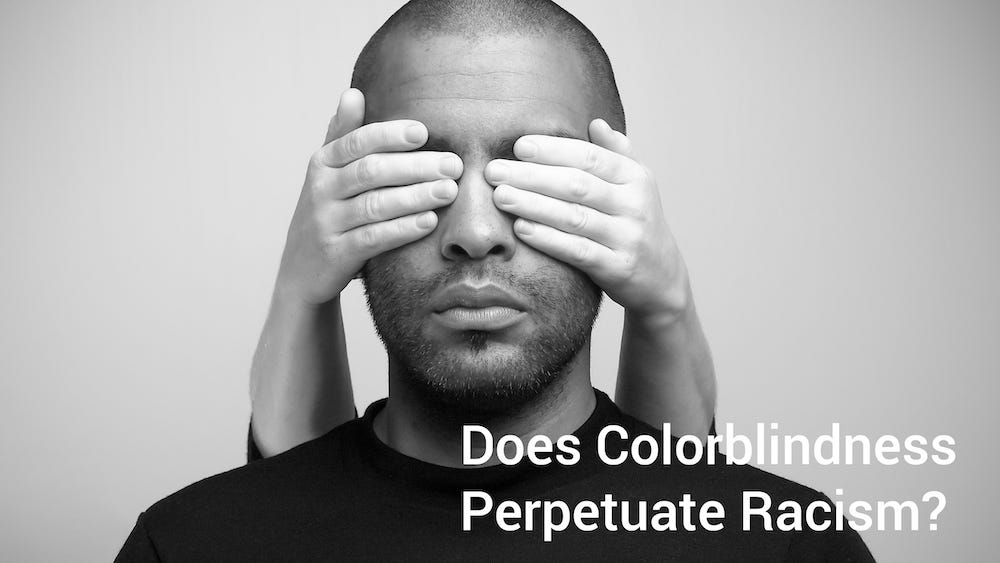
“The way to stop discrimination on the basis of race is to stop discriminating on the basis of race.”
— Chief Justice John Roberts
It is one of the most concise sentences ever written about race in America.
Simple. Memorable. Seemingly Fair.
At first glance, it seems almost unassailable. If discrimination based on race is wrong, then government should stop considering race altogether. No preferences. No special treatment. No affirmative action. No DEI. No racial classifications in hiring, admissions, or public policy.
This principle has become the philosophical foundation of the Trump administration’s approach to race and its attack on DEI programs. Its goal is what supporters describe as a “colorblind” America, one in which skin color is legally irrelevant.
The only thing that being colorblind in a racially diverse nation such as the United States accomplishes is to keep people with white skin blind to their own white supremacy.
Racial colorblindness is an appealing ideal. The problem is that it assumes we are starting from a level playing field.
We are not.
The real question is not whether people should eventually be treated without regard to race. Most Americans agree they should.
The real question is whether refusing to acknowledge race in a society still shaped by centuries of race-conscious public policy actually produces equality or merely preserves the inequalities that already exist.
That distinction is the heart of today’s debate.
Equal Rules Do Not Create Equality
Imagine two runners competing in a marathon.
One runner has been forced to carry a fifty-pound backpack for the first twenty miles. The other has been able to run unencumbered.
At mile twenty-one, the referee announces:
“From now on, everyone will be treated exactly the same.”
No one is carrying a backpack anymore. The rules are now equal. But the race is not. The burden carried during those first twenty miles still puts one runner at a disadvantage. Leveling the rules does not create equality. Equal rules do not create a meritocracy.
America’s racial history resembles that marathon more than a race beginning at a mythical equal starting line. The starting line for America’s Black people began in 1619 under enslavement. We are now over 400 years into the marathon.
Simply saying we will no longer consider race will have severe unintended consequences.
For centuries, federal, state, and local governments explicitly distributed opportunity by race. It is cynical now to suggest that by saying, “we aren’t looking at race,” it somehow means the inequities have magically disappeared.
Slavery denied wealth to millions.
Education was denied to the enslaved.
Jim Crow laws enforced segregation.
Redlining prevented Black families from buying homes in appreciating neighborhoods.
Racially restrictive covenants kept communities segregated.
Unequal schools, discriminatory lending, exclusion from many unions, and uneven implementation of the GI Bill all contributed to dramatically different opportunities for building wealth.
These were not isolated acts of private prejudice. They were intentional public policies supported by local, regional, state, and even federal law.
Many of those policies have ended, but their effects did not. Colorblindness now will not magically create equal outcomes. By claiming colorblindness, white supremacy locks in its status and continues to exist, hiding in plain sight.
The Numbers Tell the Story
If America had already achieved genuine racial equality, a colorblind approach might simply preserve status quo equality.
But today’s disparities are striking. Consider:
Wealth
According to the Federal Reserve’s Survey of Consumer Finances, the median White household holds approximately $285,000 in wealth. The median Black household holds about $45,000, while the median Hispanic household holds roughly $61,000.
That means the typical White family possesses about six times the wealth of the typical Black family.
Wealth matters because it buys opportunities. Even if the rules level the field, the past inequities have still created present inequality.
It determines whether parents can help with college tuition, provide a down payment on a first home, finance a small business, weather a job loss, or leave an inheritance.
Homeownership
The principal source of middle-class wealth in America shows a similar pattern. Roughly 74 percent of White households own their homes, compared with about 45 percent of Black households and 51 percent of Hispanic households. Those differences did not emerge by accident. They reflect decades of public policies that either opened or closed the door to homeownership depending on race.
Educational opportunity
Because public schools are largely funded through local property taxes, neighborhoods shaped by decades of housing segregation continue to produce unequal educational resources and therefore unequal outcomes. Students in many predominantly minority districts are more likely to attend schools with fewer Advanced Placement courses, fewer experienced teachers, and fewer enrichment opportunities.
Black college graduates also tend to leave school with higher student debt than their White peers, affecting their ability to purchase homes, accumulate savings, or start businesses.
None of these disparities prove discrimination in every individual case. But together they demonstrate something important: Americans are not beginning the race from the same starting line.
To suggest there is an equal starting line is foolish, self-imposed ignorance.
Colorblind Policy Freezes Opportunities
Supporters of colorblind policies argue that government should simply stop considering race. That sounds neutral and oh, so noble.
But neutrality applied to unequal conditions often preserves or freezes the inequality.
Imagine two neighborhoods struck by a hurricane.
One loses eighty percent of its homes.
The other loses only five percent.
The government announces that every neighborhood will receive exactly the same recovery assistance.
The policy is equal. The outcomes are not because the conditions are not equal.
No one can seriously argue that identical treatment automatically produces equal recovery. The same principle applies to racial inequality.
Colorblind policies did not create today’s racial wealth gap. They did not create unequal homeownership. They did not create differences in inherited wealth or educational opportunity.
But they do NOT reduce them. Instead, they accept those disparities as the baseline from which competition begins. There can be no meritocracy when the starting lines are unequal.
The Status Quo Always Benefits Those Already Ahead
This lesson extends far beyond race.
Whenever society declares, “From this point forward, everyone plays by the same rules,” those who already possess wealth, education, influence, and social networks begin with enormous advantages.
Economist Glenn Loury has argued that race-neutral institutions operating within an unequal social structure often reproduce inequality because advantages are transmitted through families, neighborhoods, schools, and social networks.
Sociologists Melvin L. Oliver and Thomas M. Shapiro similarly demonstrated that racial wealth inequality is not simply the result of individual effort but the cumulative product of generations of public policy.
Philosopher John Rawls approached the issue from a different angle. He argued that justice cannot be judged solely by whether rules are identical on paper. A just society must also ask whether its institutions produce fair opportunities for those who begin with the fewest advantages.
Their disciplines differ. Their conclusion converges: Equal rules applied to unequal circumstances reproduce unequal outcomes.
Acknowledging Race Is Not the Same as Favoring Race
One of the strongest objections to race-conscious policies is that they themselves constitute discrimination.
That concern deserves to be taken seriously. No democratic society should casually classify citizens by race. Yet there is an equally important distinction.
Recognizing the continuing effects of past racial discrimination is not the same as endorsing permanent racial preferences. It is acknowledging that history leaves institutional footprints.
As Justice Harry Blackmun wrote in his dissent in Regents of the University of California v. Bakke: “In order to get beyond racism, we must first take account of race.”
Justice Sonia Sotomayor made a similar argument in her dissent in Students for Fair Admissions v. Harvard, warning that exclusive reliance on race-neutral policies can entrench existing disparities rather than eliminate them.
Whether one ultimately agrees with those conclusions is less important than recognizing the question they pose:
Can a society honestly claim to be colorblind if the inequalities created by explicitly race-conscious policies remain largely intact?
The Difference Between Formal Equality and Real Opportunity
There is a profound difference between treating everyone the same and ensuring everyone has a genuinely comparable opportunity to succeed. Chief Justice Roberts emphasizes the first. His critics emphasize the second.
Both value equality. They simply define it differently.
One believes justice requires government to stop noticing race.
The other believes justice also requires confronting the lasting effects of centuries during which government constantly noticed race.
That is the debate America is having.
A Colorblind Future Requires More Than Colorblind Rules
Colorblindness may indeed be the right destination as Rev. King aspired to in his 1963 “I Have a Dream Speech.” It was a dream in 1963 and still is in 2026.
But it is a questionable roadmap if the road itself was built through centuries of unequal public policy.
Ignoring race does not erase the racial wealth gap. It does not erase unequal schools. It does not erase inherited advantages or inherited disadvantages.
It simply accepts them.
History has already distributed opportunity unevenly. Declaring that government will no longer see race does not redistribute that opportunity. It leaves the existing distribution largely untouched.
The irony is that a policy presented as the end of racial preference may function, in practice, as the preservation of the racial hierarchy produced by earlier preferences embedded in law and public policy.
A truly colorblind society is a worthy aspiration. But aspirations are not accomplishments.
Until Americans begin from something closer to genuine equal opportunity, refusing to see race may not end the legacy of racial inequality.
It may simply make that inequality easier to ignore.


In a graduate class years ago the professor said, "There is nothing more unequal than treating unequals equally." It took some time for me to understand and appreciate what he said. Your article today is spot on. Thanks, Dan.
Reading Caste right now. Let's ask thos question "if you policies deny a group their rights, is that not racism?